About five weeks ago, my colleague Tess McKinney walked into the UNeTech office with an opportunity.
She found a funding announcement from the U.S. Department of State that immediately made all of us stop and say, “This is really cool.”
The program was unlike anything we’d seen before—a Creative Technology Exchange that brought together healthcare, entrepreneurship, international collaboration, AI, simulation, and workforce development. It was ambitious, interdisciplinary, and just a little bit crazy.
Naturally, we loved it.
Then my boss, Joe Runge, looked at me and said something that changed the next five weeks of my life.
“I want you to be the Principal Investigator.”
There was just one tiny problem.
I had never been the Principal Investigator on a federal grant before.
For that matter…none of us had ever written a U.S. Department of State grant before.
Our team built BioReady: Global Creative Technology Exchange for Emerging Disease Preparedness, an international exchange proposal that brings together creative technologists, clinicians, researchers, entrepreneurs, educators, artists, and game developers to rethink how we prepare the healthcare workforce for the next public health emergency.
It’s ambitious. It’s interdisciplinary. It’s unlike anything I’ve ever worked on.
And it taught me far more than I expected.
Lesson #1: You Don’t Have to Know Everything.
I spent a ridiculous amount of time worrying about whether I knew enough.
- Did I understand State Department grants?
- Did I understand exchange programs?
- Was I organizing the management plan correctly?
- Were we interpreting the NOFO the way the reviewers intended?
Then I realized something. Being a PI isn’t about pretending you’re the smartest person in the room. It’s about making sure you’re almost never the smartest person in the room.
I learned to ask questions.
I learned to listen.
And I learned that asking for help isn’t a weakness—it’s literally how good projects get built.
Lesson #2: Great Ideas Get Better When You Let Other People Touch Them.
If you’ve ever worked with me, you know I love a blank whiteboard. I also love thinking I have the perfect idea.
BioReady reminded me that ideas become stronger every time someone with a different perspective challenges them.
Clinicians asked questions I never would have considered. Creative technologists imagined possibilities I couldn’t see. Commercialization experts kept asking, “Who is actually going to use this?” Global engagement professionals reminded us that international exchange is about relationships—not transactions.
Every conversation made the proposal better.
Lesson #3: Federal Grants Are a Team Sport.
I don’t think people realize how many individuals contribute to one proposal.
This project was built through conversations, edits, brainstorming sessions, emails, phone calls, coffee meetings, and more Google Docs than I care to admit.
Every section benefited from someone else’s expertise.
Every challenge had someone willing to help solve it.
That’s the part I’ll remember most..
Lesson #4: The Right Team Changes Everything.
One of my favorite parts of this experience was realizing that our leadership team is made up entirely of extraordinary women.
Each brought something completely different.
Dr. Beth Beam grounded every idea in clinical evidence and preparedness expertise, constantly reminding us that innovation only matters if it reflects the realities of healthcare.
Anna Johnston challenged us to think bigger about creative technology, immersive learning, and how artists, developers, and clinicians can build things together that none of them could create alone.
Tess McKinney never let us forget that a great idea isn’t enough. She kept us focused on customer discovery, commercialization, and building technologies that people will actually adopt and use.
Dr. Jane Meza helped us see the bigger picture, connecting simulation, workforce development, and healthcare education in ways that kept the project focused on preparing people—not just creating technology.
Dr. Hannah Tong reminded us that international exchange is about far more than travel logistics. She helped us think about cultural exchange, relationship building, and designing a program where every participant has something to teach and something to learn.
Amy McFeely asked the questions none of us could avoid. Every exciting idea was met with, “How will you measure that?” Because of Amy, BioReady doesn’t just have ambitious goals—it has a thoughtful plan to demonstrate its impact.
Monica Chatmon kept all of us moving in the same direction. Behind every meeting, every deadline, every document, and every last-minute revision was Monica’s incredible organizational skill, calm presence, and unwavering attention to detail. She made it possible for the rest of us to focus on building the project because she never stopped making sure the project itself kept moving.
Getting to learn from each of them—and somehow being trusted to bring all of those perspectives together into one proposal—was one of the greatest privileges of my career.
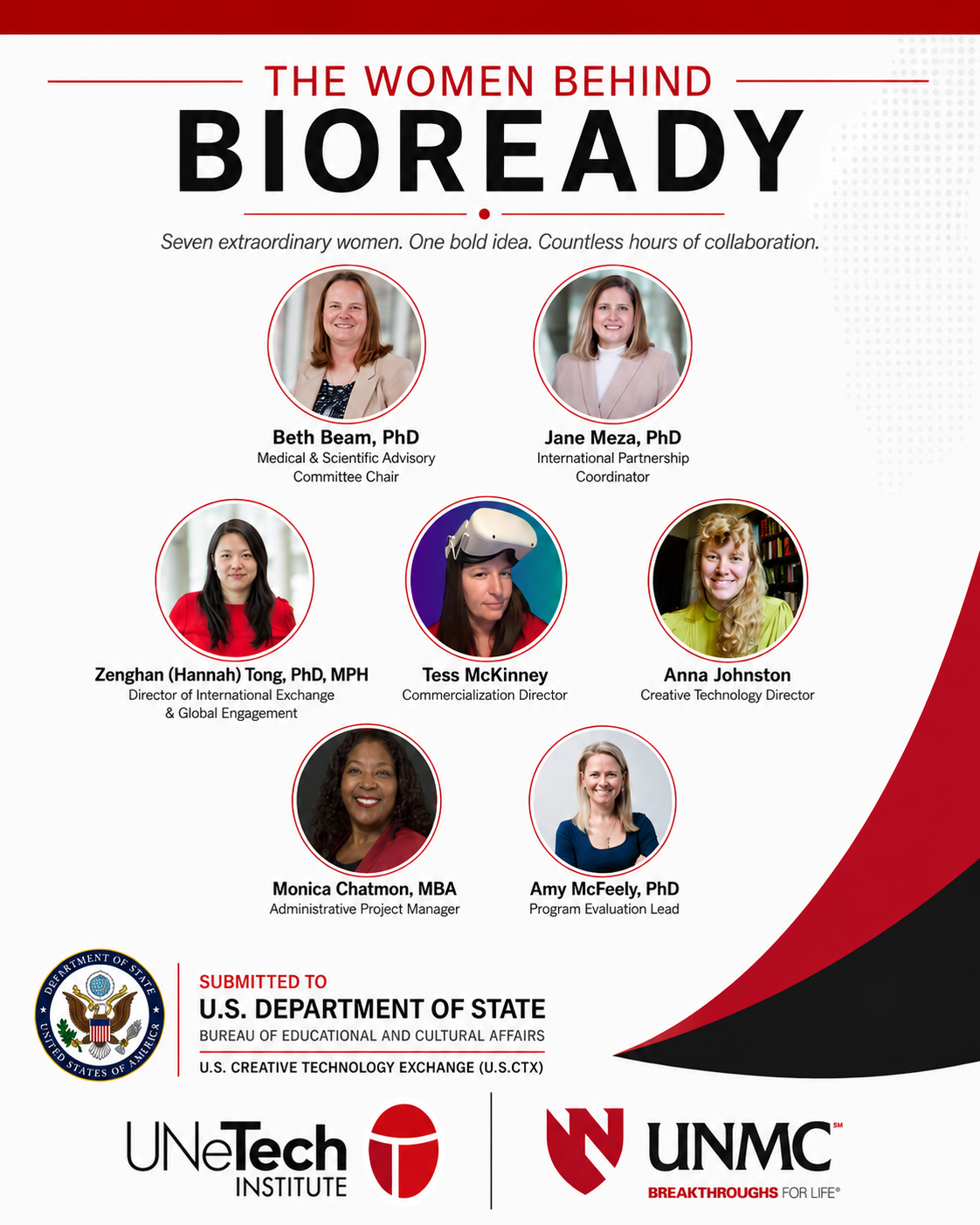
The best part of writing my first federal grant wasn’t the proposal—it was the people. Every one of these remarkable women brought expertise I didn’t have, asked questions I hadn’t considered, and made BioReady stronger because they weren’t afraid to challenge the idea. From clinical preparedness and global engagement to creative technology, commercialization, evaluation, and project management, this team reminded me that great leadership isn’t about having all the answers. It’s about surrounding yourself with people who do. Thank you to Dr. Beth Beam, Dr. Jane Meza, Dr. Zenghan (Hannah) Tong, Tess McKinney, Anna Johnston, Monica Chatmon, and Dr. Amy McFeely for making this one of the most rewarding experiences of my career.
Lesson #5: Partnerships Aren’t Just a Requirement.
They’re the project.
One of the greatest joys of this experience was seeing how many organizations wanted to be part of something bigger than themselves.
Thank you to the incredible partners who helped shape BioReady and shared our vision:
- University of Nebraska Medical Center
- UNeTech Institute
- Office of Global Engagement
- Davis Global Center
- Nebraska Biocontainment Unit
- Omaha Virtual Reality Pipeline (OVRP)
- Metropolitan Community College
- Category 1 Consulting
- XR Renegades
- The City of Omaha
- Our international creative technology partners and artists who believed in this vision from the beginning.
Every conversation strengthened the proposal. Every letter of support reminded me that meaningful innovation is always collaborative.
And Finally…
Whether BioReady is funded or not, I’m proud of what we created.
I’m proud of the relationships. I’m proud of the countless revisions. I’m proud that we built something rooted in collaboration instead of ego.
Most of all, I’m grateful.
Grateful to everyone who answered a question, reviewed a paragraph, challenged an assumption, shared expertise, or simply believed this crazy idea was worth pursuing.
This project changed me. It made me a better grant writer. It made me a better collaborator. And I think it made me a better leader.
Now…I’d really like to never look at another federal budget narrative for at least a week.
If you’d like to stay connected with us, be sure to sign up for our newsletter or follow us on LinkedIn and Instagram for updates, insights, and new opportunities. If you’re a student, entrepreneur, or investor interested in working with us, you can connect directly with a member of our team—we’d love to hear from you.