When the Steel Works Health Accelerator launched, it was “only an idea on paper.” Tyler Scherr, UNeMed’s Licensing Specialist and Business Development Manager, has now seen the program through to its conclusion. On June 10, the Steel Works Health Accelerator closes out its first full run, and the founders who went through it are coming out the other side sharper, more confident, and more connected than when they walked in.
“Steel Works Health Accelerator was formed as a complement to UNeMed and UNeTech, with the goal of forging investable health tech startups in Nebraska,” said Dr. Scherr. “It’s been a real pleasure to partner with UNeTech and CQuence Health, and I can’t wait to see what the graduating founders achieve.”
As that idea has taken shape, Steel Works has transformed Nebraska health innovations into investment-ready companies. Funded by a U.S. Small Business Administration grant secured by UNeMed and built in partnership with the UNeTech Institute and CQuence Health, the three-month program paired six startups with hands-on coaching, workshops, and mentorship. The Steel Works program was led by CQuence’s healthcare strategy team. The goal wasn’t just a polished pitch deck. It was clarity: about value, about audience, and about what makes each company genuinely different.
But you don’t have to take the accelerator’s word for it.
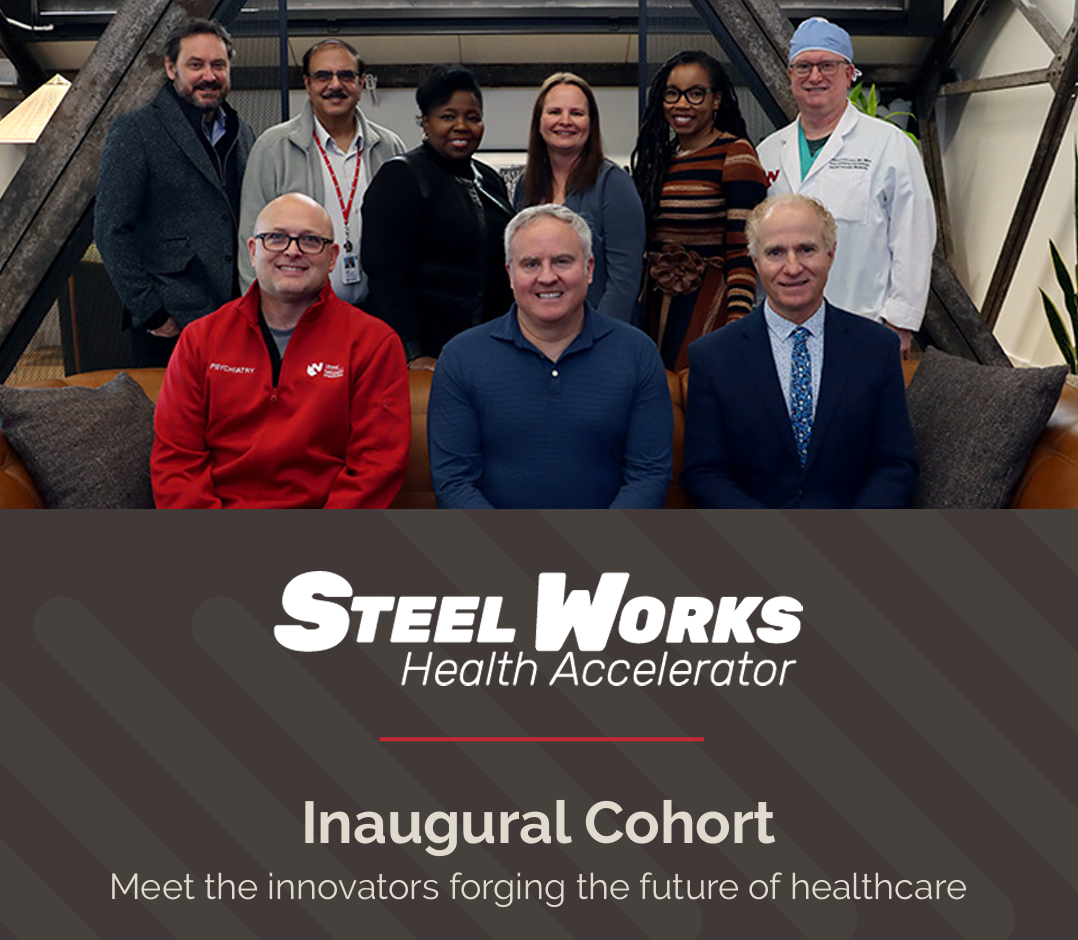
Back Row: Kirk Zeller, Ashok Puri, Sheila Fields, Elizabeth Beam, Marcia Shade, Edward O’Leary.
Front Row: Stephen Salzbrenner, Tim Crane, and Ronald Krueger.
For Steve Salzbrenner of BreezMed, the difference was being taught by people who live and breathe healthcare investing. The program, he said, “allows clinicians like me to change the paradigm a little bit”—to learn how to frame healthcare innovation in a way that “appeals to a more value-oriented audience.” The individual coaching sessions with CQuence staff stood out. “They’re a colleague,” Dr. Salzbrenner said, “but they’re speaking from experience you don’t have.”
Shiela Fields of RxNex Solutions called the partnership “a powerful catalyst,” one that deepened her understanding of the healthcare domain and helped her “translate insights into a scalable solution” while learning “how to grow and develop for funding.” What she valued most was the shape of the program itself: “I like the structured support, the mentorship, and the accountability.” Standing in a room full of investors and getting honest feedback on her pitch—learning to “articulate concisely what the vision is as a founder”—left her with a simple verdict: “I wish I’d done this years ago.”
Marcia Shade brought a different perspective to the accelerator. Dr. Shade was a graduate of the National Institute on Aging’s Start-Up Challenge. She brought that experience to steel works, so that “participating in Steel Works allowed me to get more granular and build on the foundation… pressure testing the things I had in place”. Dr. Shade felt that pressure while pitching to a room full of people at the mid-point pitch session. She received frank feedback, “doing that and being vulnerable and taking the feedback, not being able to say anything and forcing myself to be open and listen instead of responding. I think that’s a valuable life skill.”
Beth Beam of RedSentrix pointed to the conversations about her company’s value as the most eye-opening part. Delivering an elevator pitch to a panel of experts, she said, gave her a response that “sat me back—I needed to process that and not respond to it.” The lesson stuck: “You can get really lost in the weeds of your problem. The important thing is to stay forward-focused—confident in how your product will impact the market.” Dr. Beam left knowing how to “prioritize the key things that make us different and better, because they’re undeniable”—and how to tell that story differently to “people who are business-minded versus people who care about the problem.”
Steel doesn’t come from a single source. The Steel Works Health Accelerator took the expertise of academic leaders, the experience of partners like UNeMed and UNeTech, and the fire of CQuence Health, a healthcare investor. The accelerator forged it together with the raw material that mattered most: six founders and their innovations. Combined under the right conditions, they became something stronger than any single element alone.
“The inaugural Steel Works cohort highlights the talent and entrepreneurial spirit driving healthcare innovation in Nebraska,” said Stephen Hug, entrepreneur-in-residence at UNeTech. “Through the program and its partnership with CQuence Health, the founders received valuable guidance from experienced healthcare entrepreneurs and mentors and strengthened their ventures for future growth. Equally important, they built relationships that will continue to support innovation and collaboration across our ecosystem.”
See it for yourself. The first Steel Works cohort takes the stage on Tuesday, June 10, at the Catalyst building, with founder pitches from 3:30 to 5:30 p.m. in the Forge Events Hall, followed by an after-party in the Passageway. Everyone is welcome. Please join us and see what the community has forged.
If you’d like to stay connected with us, be sure to sign up for our newsletter or follow us on LinkedIn and Instagram for updates, insights, and new opportunities. If you’re a student, entrepreneur, or investor interested in working with us, you can connect directly with a member of our team—we’d love to hear from you.