Good evening and welcome back to the Start-Up Update. My name is Joe Runge, and tonight’s guest spent six months searching the globe for the best respiratory technology — dozens of universities, hospitals, and tech-transfer offices across the entire globe. Where did the search end?
>gestures manically at backdrop<
Stay tuned to find out how.
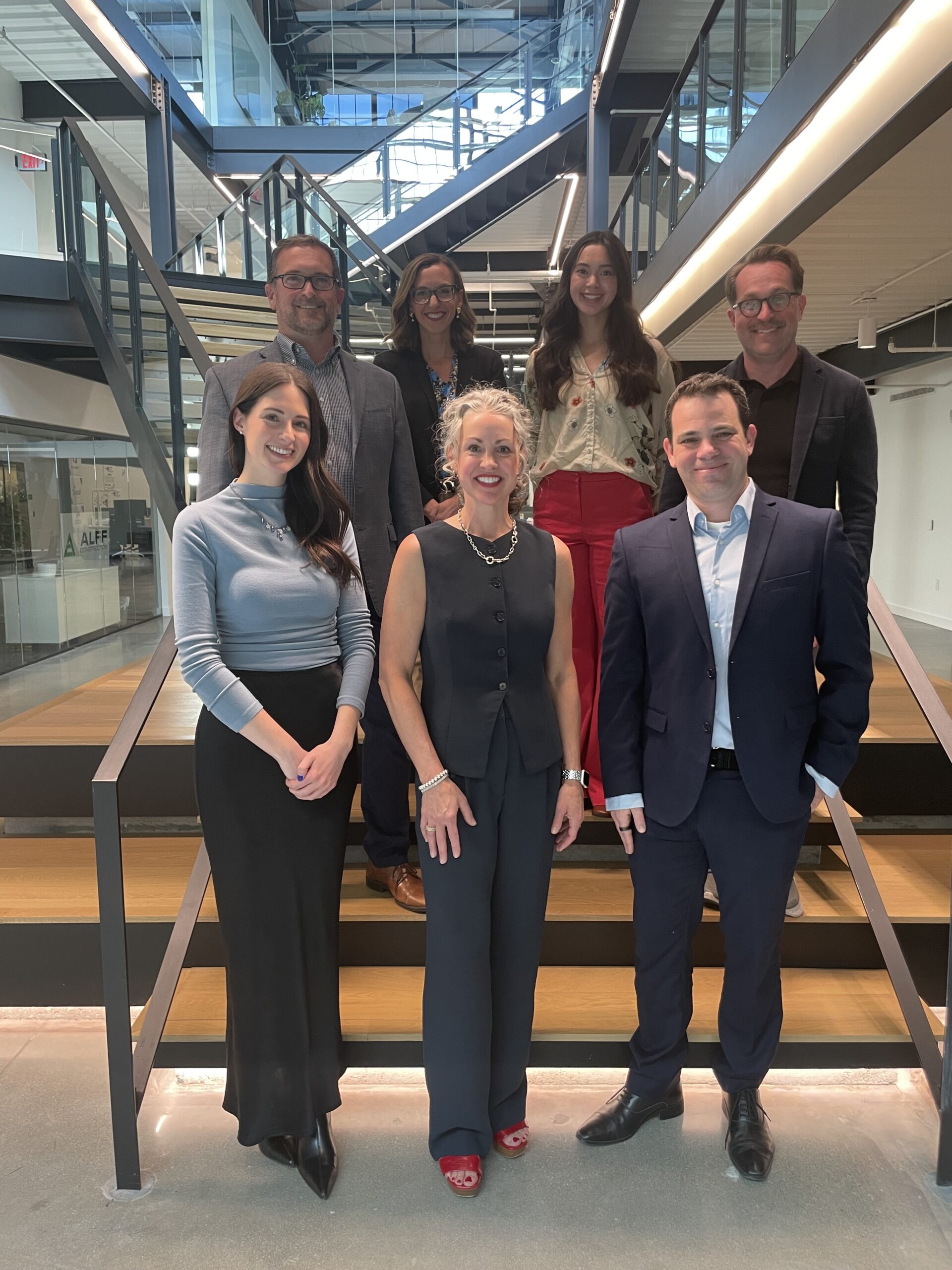
At the RespirAI Launch Party in spring 2026 at their new home in the Catalyst Building.
Front row from left to right:
Back row from left to right:
Start-Up Update is a feature here at UNeTech.org where we periodically check in with our founders and their startups. We see what’s been happening for these startups by asking way too many questions. Among that series of questions are three big ones:
The first is, “Do you remember the first time you heard about the technology?” Every startup journey begins somewhere—in this case, with a single breath.
The second asks founders to look back and consider what an earlier version of themselves might have thought about what it would mean to lead a technology startup.
And the last is the simplest: What’s next?
Nimrod Bin-Nun is the co-founder and CEO of RespirAI, which licensed a revolutionary invention jointly invented between the University of Nebraska Omaha and the University of Nebraska Medical Center. The invention combines the insights of global experts on chronic obstructive pulmonary disorder at UNMC and the world-class department of biomechanics at UNO. Together, they built a respiratory-monitoring technology: hardware, software, and an algorithm, and with early support from UNeTech, launched a national pilot study of patients suffering from COPD. Even in its early state, the invention caught the early warning signs of a COPD flare-up days before it lands a patient in the hospital. With R&D in Israel and its headquarters in the United States, in 2026, RespirAI is running two expanded pilot studies, has launched a mobile app, and is poised to make 2027 an even bigger success.
You’ve heard the questions before (well, once before), but Nimrod hasn’t. So let’s get the startup update, straight from the horse’s mouth!
The Search
I asked Nimrod about the first time he encountered the technology that would become RespirAI. His answer started somewhere unexpected: not with the technology at all. Instead, Nimrod shared part of his own story that was new to me.
“I’m familiar with some startups that start from the technology and then look for solutions,” he told me. “What we believe is that a better way is to start with the problem and then look for the solution.” He and his co-founder, Asaf, (Assaf Gur, Chief Technology Officer (CTO), and Vice President of R&D at RespirAi) came at healthcare from opposite ends—Nimrod from the business side, Asaf from R&D, regulatory, and clinical—and they agreed on the discipline of it: identify the unmet need first, then go hunting.
The need was already in the air. “It was the beginning of the COVID pandemic,” Nimrod said. “We knew that there is a black box there, and there is a need to monitor these chronic respiratory patients at home.” So the two of them started to look. For six months they scanned technologies globally—dozens of tech-transfer offices, hospitals, and universities—looking at a wide range of respiratory diseases.
What stopped the search was a listing in a University of Nebraska portfolio, and it stood out because it was, in Nimrod’s words, “much more than just a patent.” The IP came in two halves, hardware and software, and the combination had already been tested—not only on healthy volunteers but on COPD patients, too. There was early clinical data, basic but real, and a standing collaboration between a university and a hospital behind it. “The combination of the device, the algorithm, the clinical data, wa much more advanced and mature than other things we saw in other universities,” Nimrod said. Support on both sides, and something they could actually start building with.
The search that spanned the globe ended about 1.3 miles from where I’m sitting.
The Pause
For the second question, I asked Nimrod to picture his younger self—an analyst in his first year at Teva, the Israeli generic-drug giant—and imagine explaining that he’d one day be in Omaha, Nebraska, supervising a clinical study for a technology licensed from another country, running trials on two continents.
He laughed a little at the geography. “I never thought I’d find myself in Nebraska,” he admitted. “Ninety two percent humidity?” But the arc itself would not have surprised the younger man. “I always wanted to be an entrepreneur,” he said. “I built myself to be a CEO. I tried to collect different types of expertise.”
It helped that he came wired for the work. “I have a quite unique background—degrees in both biology and economy,” he said, which slotted him neatly into business-development roles that wanted a scientific mind. At the start, Nimrod said he thought pharmaceuticals were the entire world; it took an MBA, sitting among people from other industries, to see how much else was out there. So he made a practice of the discovery. “I decided to have a virtual pause every few years,” he explained. “To open the spectrum, to look for my opportunities, to build myself to the next phase.” New position, new technology, roughly every two or three years, inside Teva and out.
Teva, he says, was an amazing school. He started in the Asia-Pacific region (APAC) and, by 26, was flying around APAC, the US, and Europe on his own, working with manufacturing sites in the US, China, the Netherlands, and Israel. Working out of a small home market, he said he learned early to look outward. “You need to think global,” he said, “and this is what I did from day one.” Looking back, he said he wouldn’t change the route. “If I’m looking at my career now, I would do this exact same pathway.” His younger self, he figures, would read RespirAI and Omaha as graduation. The plan worked.
Which raises a tension worth sitting with in 2026. Nimrod spent his career watching the global economy unfurl and grow; lately the tide has turned toward regions and borders. His answer is a paradox he repeats like a mantra: “Although we like playing like a global company, we’re still very, very local.” RespirAI has R&D in Israel and a headquarters in the US, but every effort right now points at a single market—the US—chosen precisely because it’s unified. “One reimbursement system, one regulatory system, one language,” he ticked off. Europe would be more global, and more complicated. Germany, the UK, China, even Israel—each an opportunity the company has deliberately held. “We are still in the proof-of-concept stage,” he said. “We still need to prove to everyone that there is a value behind the technology, there is a market behind the technology, and that people can adopt it.”
The Convergence
What’s next runs on two tracks at once.
The first is regulated. RespirAI’s lead products are built for early detection—flagging a COPD exacerbation, or a pneumothorax, before it becomes an emergency. Two pilot studies are underway in Nebraska with Methodist Health, with Mayo Clinic and other US sites in the wings. One product line targets hospitalizations; the other, admission rates. Nimrod said he expects both pilots to wrap by the end of this year or the start of next.
The second track is the platform itself—unregulated and already live. “We develop a holistic solution for the chronic respiratory patient,” Nimrod said. The mobile app, launched a few months ago, works from both sides: patients monitor their own condition and share it with caregivers and clinicians, while a dashboard lets clinicians see how those patients are doing at home. No alerts yet—those come later—but even without them, he said he believes today’s Medicare remote-monitoring codes (RPM and RTM) can support it. “It’s like a one-stop shop for the COPD patient on a daily basis,” he said—and, he added, currently the only real window a clinician has into that patient between visits.
The two tracks are built to converge. By the end of 2027, when the regulated products are ready, RespirAI plans to fold those cleared features into the platform it’s assembling now—clinics, home-care infrastructure, reimbursement, patients, all of it. Until then, deliberately low-profile. “We’re not going to generate a million dollars,” he said. The point is to prove the whole flow works and can be paid for.
The stakes underneath it are stark. According to the World Health Organization, COPD is the third leading cause of death globally. According to the Centers for Disease Control, it is the fourth leading cause of hospitalization in the US. There are ways to treat it, but patients live with flare-ups no one sees coming.
Nimrod’s whole thesis fits in one sentence he’s clearly said many times: “If we could provide an alert a few days before hospitalization, the clinicians can step in earlier, and by providing antibiotics or steroids we can reduce the severity of the flare-up dramatically and keep these patients at home.” And beneath the hospitalizations and the burden, the number that matters most. “Most importantly,” he said, “is to save these patients’ lives.”
And COPD is only the first indication. “We’re talking about asthma. We’re talking about CF (cystic fibrosis), maybe a cardiac solution, maybe post-hospitalization, collaboration with pharmaceutical companies, even some wellness applications,” he said.
Then, Nimroad said, the algorithm will “expand to other indications, other territories—and sky’s the limit.” The entrepreneur who once thought pharma was the whole world is, these days, very disciplined about staying focused: one market, one disease, one thing to prove first.
RespirAI is a very personal project for me — your neutral and detached host. When the invention first crossed my desk over a decade ago, I knew it was something special. The success of the project is a matter of enormous personal pride. Although in retrospect it was obvious, it was only in our studio set did I realize how personal it was for Nimrod, too. The technology, yes, he is passionate about bringing new solutions to manage a disease that truly is a global scourge. In a summer when the world feels fractious, I am so grateful to have this story to tell.
And that’s our show! A huge thank-you to Nimrod and Asaf; to Jonell Tempero; to William Denton, Amol Patil, Stephen Rennard, Nik Stergiou, and Jennifer Yentes; to the teams at Nebraska Methodist, Mayo Clinic, and Right at Home; and of course, to the UNeTech Institute and UNeMed Corporation for helping this technology find its way from a patent portfolio toward a patient’s home. Watch this space for more Start-Up Updates!
If you’d like to stay connected with us, be sure to sign up for our newsletter or follow us on LinkedIn and Instagram for updates, insights, and new opportunities. If you’re a student, entrepreneur, or investor interested in working with us, you can connect directly with a member of our team—we’d love to hear from you.