Warren Buffett has spent decades explaining how to build wealth. But some of his most important lessons aren’t really about money at all. In fact, one of his most famous reflections about success has almost nothing to do with investing. Speaking to students at Georgia Tech about how he measures success at the end of life, Buffett once said: “Basically, when you get to my age, you’ll really measure your success in life by how many of the people you want to have love you actually do love you.”
He went on to explain that money, prestige, and recognition don’t pass that test.
“I know many people who have a lot of money, and they get testimonial dinners and they get hospital wings named after them. But the truth is that nobody in the world loves them.”
It’s a striking thing for one of the wealthiest investors in the world to say. But if you work in entrepreneurship long enough, you realize Buffett is exactly right.

Warren Buffet created his Twitter account in 2013 while sitting in UNO’s Mammel Hall. His first Tweet from his account @warrenbuffet read: “Warren is in the House.” (Photo courtesy of the UNO Gateway.)
Relationships Matter Most
Buffett tells us: “The trouble with love is that you can’t buy it. You can buy sex. You can buy testimonial dinners. But the only way to get love is to be lovable. It’s very irritating if you have a lot of money. You’d like to think you could write a check: I’ll buy a million dollars’ worth of love. But it doesn’t work that way. The more you give love away, the more you get.”
At UNeTech, this idea isn’t philosophical. It’s operational. It’s the foundation of how we think about innovation, startups, and building an entrepreneurial ecosystem here in Nebraska.
Entrepreneurship Is a Team Sport
The mythology of entrepreneurship loves the image of the lone genius: the founder in a garage, the brilliant individual who disrupts an industry through sheer determination.
It’s a compelling story. It’s also mostly fiction.
In reality, entrepreneurship is profoundly relational. Ideas become companies because someone introduces a founder to an investor. A prototype becomes a product because a mentor asks the right question.
A research discovery becomes a startup because someone helps translate it into a real-world problem that customers care about.
At UNeTech, we see this every day.
A researcher might arrive with a promising technology. But what unlocks progress isn’t the technology alone. It’s the network around it—mentors, investors, students, researchers, community leaders, and collaborators who all help shape the path forward.
That’s why we spend so much of our time building connections.
- Between founders and investors.
- Between students and industry leaders.
- Between research and the people who can actually use it.
Buffett’s insight about love and relationships might sound sentimental in a business context. But in entrepreneurship, it translates directly into something very practical: trust.
And trust is the currency that moves innovation forward.
Nebraska Understands This Better Than Most Places
In Silicon Valley, the narrative often celebrates speed and disruption. In Nebraska, our advantage is something different: community. People know each other here. They introduce founders to the right partners. They make time for coffee conversations that turn into collaborations months later. Some of the most important entrepreneurial moments we see don’t happen in boardrooms or pitch competitions.
They happen across a table.
- A founder meets someone who asks a better question.
- An investor hears about a technology through a trusted colleague.
- A student realizes their research might actually become a company.
Those moments look small from the outside. But they are exactly how ecosystems grow.
Buffett understands this dynamic instinctively. His entire career has been built not just on financial intelligence, but on long-term relationships. People trust him. They partner with him. They call him first when something important is happening.
That kind of reputation doesn’t come from a spreadsheet. It comes from decades of showing up for people.
Customer Discovery Is Relationship Building
One of the places we see this philosophy play out most clearly is through the work we do with the NSF Great Plains I-Corps program.
At its core, I-Corps teaches a deceptively simple lesson: talk to people.
Researchers and founders interview potential customers, partners, and stakeholders to understand the real problems their technology might solve. The process is structured. It’s methodical. But fundamentally, it’s about relationships.
A scientist who has spent years focused on a lab discovery suddenly sits down with clinicians, patients, or industry experts and asks: What do you actually need? Those conversations reshape ideas. They reveal blind spots. They open doors. But they also build something else: mutual respect.
When someone feels heard, they’re far more likely to stay engaged. They become advisors. Champions. Early adopters.
When Teresa Friesen participated in the spring 2026 I-Corps program through the University of Nebraska Omaha, her technology SheMate was already well-established. She completed a series of interviews with young athletes, their parents, and athletic coaches. She said the interviews with coaches were surprisingly informative.
“Interviews showed me that we need to be a better resource for coaches because they are already doing an exorbitant amount of work for their teams,” Teresa said. “When research conclusively demonstrates the benefits of young people engaging in extracurricular activities, we need to wrap coaches in all the resources they need to ensure that youth can reap the benefits of sports participation. Our company can now be the resource that coaches employ and players need.”
Buffett’s principle applies here, too: the more value you give to others, the more it comes back.
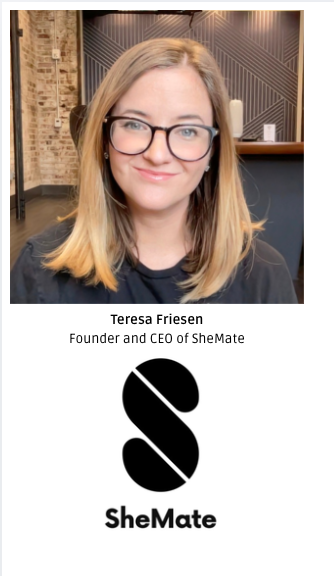
Teresa Friesen, founder and CEO of SheMate and the logo of her startup. (Photo courtesy of Friesen.)
Students Learn This Early
One of the most encouraging things we see through programs like the University of Nebraska Omaha Maverick Technology Venture Alliance is how quickly students grasp the importance of relationships.
They arrive thinking entrepreneurship is about having the best idea. Within weeks, they realize something else: progress happens through collaboration. Students interview founders. They work with researchers. They engage mentors across the ecosystem.
UNeTech’s Strategy & Ventures Manager Lamonte Russell is in the classroom with the MTVA each week. “Managing the MTVA, I have learned that building strong relationships with faculty inventors, student analysts, university leadership, investors, and community partners is crucial for successfully transforming an idea from concept to commercialization,” Russell said. “Our close collaboration with the UNeTech Institute, UNeMed, and the University of Nebraska Omaha ecosystem has demonstrated that entrepreneurship flourishes when collaboration is deliberate, and relationships are nurtured over time.”
They learn that innovation is not a solo act.
And that lesson matters far beyond startups. It shapes how they lead teams, build companies, and contribute to their communities.
“The MTVA has shown me how tight-knit the entrepreneurial ecosystem really is,” UNO graduate student and MTVA graduate assistant Shona Juliana said. “People are always willing to help, and that has helped me view entrepreneurship differently. It does not have to be something you do alone. A big part of entrepreneurship is learning how to lean on the people who can help you grow and help take some things off your plate.”
Why Solopreneurship Is a Myth
There is another idea that circulates widely in startup culture: the romantic vision of the solopreneur. The founder who does everything alone. The individual who refuses help. The entrepreneur who prides themselves on independence. In practice, that model rarely works.
The companies that succeed are surrounded by people who challenge ideas, open doors, and provide guidance.
Buffett’s observation about love captures something deeper about human success. The relationships you build throughout your life become the measure of what you’ve contributed to the world.
Entrepreneurship is no different.
Startups grow through networks of trust. Investors fund founders they believe in. Communities rally around companies that reflect shared values. “The likelihood of being a single individual able to do it all themselves without a pre-existing community, without funding, without team members, is an incredibly obscure statistic,” Joe Toscano CEO and founder of Service Stories, said.
His startup Service Stories began as a way to solve a marketing problem for his family’s auto shop, Gateway Auto. He grew his family’s auto shop 4× through SEO-driven digital transformation and created Service Stories to turn repair orders into content—boosting direct traffic 400% in under five months and scaling the solution to service businesses everywhere.
He said he knows he could not have done it alone.
“I have friends who have done it. They’ve scaled the product by themselves; they didn’t require any funding, but they had big communities online.” Toscano said those communities might not have been local or even communities of in-person relationships, stressing instead the importance of the online ecosystem. “No great company was ever built in an isolated vacuum; that’s always been true, and I think it will always continue to be true.”
The strongest ecosystems are not built on competition alone. They are built on collaboration.
“The strongest leaders are not those who seek to control every outcome, but rather those who build trust, remove barriers, and help others succeed,” Russell said. “This is how our MTVA venture analysts grow and thrive.”
Doing Work You Love
Buffett offers one more piece of advice that resonates strongly with founders:
“In the world of business, the people who are most successful are those who are doing what they love.”
Anyone who has spent time around entrepreneurs knows how true that is. Startups are difficult. They require persistence, creativity, and resilience through uncertainty. No one does that work for long unless they believe deeply in what they are building.
At UNeTech, we’re fortunate to work with founders, students, and innovators who feel that sense of purpose. They care about solving real problems — improving healthcare, advancing technology, and building companies that strengthen our region.
That passion is contagious.
It’s also what makes an entrepreneurial ecosystem thrive.
The Real Measure of Success
Buffett’s definition of success might seem unusual coming from one of the most successful investors in history. But in many ways, it’s the most practical advice he could give. Success isn’t measured only in financial returns. It’s measured in the relationships you build along the way.
In Nebraska’s innovation ecosystem, we see that truth play out every day.
- Founders succeed because mentors invest their time.
- Students grow because experienced leaders share their knowledge.
- Ideas become companies because communities choose to support them.
Entrepreneurship, at its best, is a collective effort.
And when you step back and look at the people who make that effort possible—the founders, students, mentors, investors, and partners who believe in each other’s work—you realize something.
Warren Buffett was right.
Relationships aren’t just part of success; they are the whole point.